
©copyright-by-richard_s_ehrlich-IMG_0000ps4cpcr.jpg
On the outskirts of Lhasa, Tibetan mourners whispered prayers, while hungry brooding vultures circled overhead.
Cawing.
"This is our sky funeral. We let the vultures eat the bodies of dead Tibetans," a mourner said as we sat on rocky dirt among other Tibetan mourners at the beginning of the somber rites.
"I personally think it is too gruesome. But this is our Buddhist tradition."
Cremations and burials are difficult to perform.
Firewood is scarce throughout much of Tibet.
The ground is often frozen or rocky.
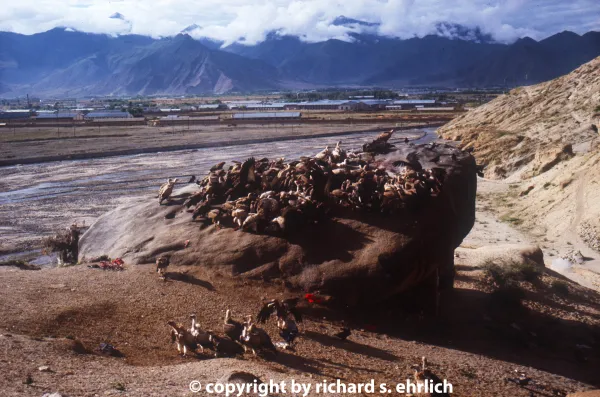
A gray boulder looming 30 feet high, served as the cold altar for Lhasa's Tibetan corpses.
The flat boulder's 20-foot by 20-foot surface could be used every day except Sundays.
Sky funerals -- "bya gtor" or "alms for the birds" -- began at dawn with attendees moaning prayers.
"Today, four bodies," the mourner quietly explained.
"You can see, three of the dead are village women.
"Also a merchant. He is a murder victim. He was killed two nights ago in the Lhasa market at a card game. Stabbed.
"We are all friends of the dead. The brothers, sisters, parents and children don't come to these funerals."
This morning was chilly and clear.
The sun smoldered behind snow-covered mountain peaks while four Tibetan undertakers -- "rogyapa" or "body breakers" -- and two assistants laid the four corpses face down on the boulder.
The undertakers pulled off the bodies' shoes.
Mourners glanced at the slumped, immobile humans, then looked away.
More friends arrived to honor the deceased.
Visitors came in battered, dusty, green Chinese trucks.
The vehicles veered off a dirt road, rattled across a small, flat garbage dump, and splashed through an icy, shallow brook.
The trucks stopped near the blood-stained boulder.
The all-male passengers climbed down and solemnly trudged towards the rock which rested amid treeless lunar foothills dotted with ragged Buddhist prayer flags on the northern outskirts of Lhasa below the stone wall of the 15th century Sera Monastery.
Vultures swooped and spiraled, or simply loitered atop a nearby cliff.
The birds of prey looked down upon the living and the dead, waiting for the ritual to begin.
Six undertakers, reeking of cheap Tibetan "chang" beer, used thick ropes to noose the necks of the bodies.
They attached the ropes to a very heavy stone.
This prevented the bodies sliding off the boulder's slightly angled surface.
The mourners were becoming increasingly miserable.
They clustered around small campfires a few yards away, below the boulder.
Some used dented aluminum tea pots to brew hot tea laced with yak butter and salt -- a popular nourishment.
Overhead, more vultures circled and cawed.
Some of the birds hopped unafraid onto the boulder and inspected the cadavers.
A few of the two dozen mourners quietly joked and gossiped among themselves.
The undertakers, in filthy, blood-splattered aprons and knee-high boots, pulled out their whetstones.
They sharpened vicious, 18-inch knives and heavy cleavers.
Someone tossed a mixture of dried yak dung, roots and seeds onto eight small campfires below the rock and five tiny fires on the boulder's surface.
The heaving smoke was to signal distant vultures that a sky funeral had started.
A noisy flock of about 150 vultures now swooped above the boulder but didn't land.
The drunk undertakers appeared numb to the slowly unfolding horror.
With heavy, grabbing gestures, they unceremoniously ripped the clothes off the corpses.
The bodies were now completely nude.
Face down.
As a grim backdrop, Tibet's dreaded Drapchi Prison sprawled nearby.
The butchering was terrible to watch.
It had all the rawness of a medieval slaughterhouse.
Each of the four undertakers quietly worked separately on a single body.
They chopped off flesh.
Cut away the dark red muscles down to white bones.
Dismembered limbs.
With bare hands, they scooped out each heart.
They yanked out internal organs, briefly inspected the ugly tangle, and tossed it aside.
Hacking sounds made by their blades, pierced the silent dawn.
Amid the gore, the undertakers revealed efficient techniques.
With knives and cleavers, they chopped the flesh and muscles into chunks and tossed the pieces from all four corpses into a central pile on the boulder's surface.
They discarded the bones into a separate pile.
The two attendants, with heavy hammers, sat and pounded the bones into a powdery gruel while chanting Buddhist prayers of emancipation.
They eventually made a tasty mash by mixing "tsampa" -- roasted barley flour and yak butter -- together with the corpses' minced meat to entice the vultures.
They sprinkled the powdered bones over the entire meal, to ensure the bones would also be eaten.
The result resembled a huge, bright red, sinewy, chunky, raw hamburger on the dark gray boulder.
One mourner placed a handkerchief over his mouth to filter the stench.
From time to time, assistants brought the undertakers large containers of chang barley beer and steaming tea to drink.
Saved for last were the four severed heads.
Cheap earrings dangled from the three women's ears.
Undertakers inspected the heads before proceeding.
One by one, they gripped each severed head by the hair and held it high up, watching as the shredded blood vessels, neck muscles and connecting flesh dangled from the skinned neck.
In the early morning light, each undertaker appeared as if portrayed in Italian Baroque artist Caravaggio's painting of David with the Head of Goliath or as Judith with the Head of Holofernes, painted by Allori.
The undertakers stared at the heads and the drooped faces.
Most of the blood had coagulated, but some dripped onto the rock into shallow circular puddles.
Mourners watched transfixed, gazing up from below the boulder.
Most mourners then looked away.
The undertakers casually placed the four heads on the boulder's surface and used the sharp points of their knives to cut into the flesh, forming a big circle around each person's face.
They deepened the slices across the foreheads, at the hairline.
With blood-splattered fists, each undertaker clutched the hair above the corpse's sliced forehead and pulled it backwards while hacking two gashes along the sides near the ears.
They chopped off most of the heads' hair and lobbed those chunks away from the boulder.
The undertakers then grabbed each grimacing dead face at the forehead using their right hands, and also stuck the fingers of their left hands into each corpse's mouth.
Strongly pulling in opposite directions, they began yanking off each scalp.
It was as if they were removing a stubborn, glued-down wig.
After a final pull, they tore away the scalp, exposing the skull's dome, glistening white and flecked with red gristle.
An assistant silently laid out a white cotton sheet onto the boulder's surface.
The undertakers cut each scalp into hand-size chunks and tossed the pieces onto the cloth along with any remnants of flesh.
The undertakers then picked up the scalped heads and, with several hard, downward tugs, skillfully yanked each face completely down and away.
Each removed face formed a bloody, pouch-like, rubbery mask.
The exposed skulls displayed macabre red and white skeletal expressions rendered with small shreds of the remaining muscle and bone.
Another assistant offered the undertakers hot tea.
Some mourners, each holding a handkerchief over their mouth and nose, clumsily climbed onto the boulder for a brief closer look before climbing back down.
The two assistants then sat and continued hammering any remaining bones into powder while softly singing.
Suddenly, all work stopped.
One of the undertakers jumped off the boulder.
Searching nearby, he found the heaviest rock he could carry and climbed back up onto the boulder's surface.
He stood over a bloodied skull which he had laid on its side.
The other undertakers stared at him.
Slowly, he raised his heavy rock above his head, as high as he could.
Then, with all his strength, he hurled the rock down onto the skull.
The skull cracked with a sharp, breaking sound.
But it did not crack completely open.
So he retrieved his rock, stood above the head once more, and hurled it down, smashing the rock onto the oval skull.
Finally, on the third attempt, the skull cracked open wider, partially exposing an encased brain.
The delighted undertaker smiled.
He proudly and delicately picked up the cracked skull and, with a shout and wave of his hand, told all the mourners to pay attention.
While they silently watched, he carefully held the skull high in the air so everyone could see and, with his large hands, opened it like a giant breakfast egg.
The brain dropped onto the smooth boulder with a quivering plop.
Everyone gawked at the soft, round brain.
The undertaker nonchalantly discarded the skull's two broken pieces onto the pile of bones to be hammered.
He then gently tossed the brain onto the other pile of tsampa-flavored flesh.
A nearby undertaker picked up the heavy rock and laughingly pretended to try and smash the now-exhausted undertaker's head.
Another undertaker jumped off the boulder, found another heavy rock, climbed back up and smashed another corpse's skull, following his colleague's assault technique.
The other undertakers repeated the process with the remaining skulls.
When an assistant offered one of the undertakers a glass of tea, he replied, "My hands are too bloody. Hold and tilt the glass and I will drink from it."
Only one of the undertakers wore gloves.
The hands of the three others were soaked in blood.
Soon, all six men climbed off the boulder.
"Come! Eat!" an assistant called out, throwing a small piece of human flesh off the boulder to attract the vultures.
The other assistant shouted at the mourners, "Sit down! You are scaring the vultures away!"
More than 100 huge birds swarmed down from the sky and landed on the boulder's surface.
They displayed sleek, white feathers around their beaked heads and long necks.
They were fat from frequent funerals.
But the vultures soon became frenzied and competed for whatever they could eat.
They battled each other, ripping chunks of stretchy, sinewy flesh and organs out of each other's beaks.
They squawked, tearing at their feast.
Devouring everything.
Soon only small puddles of blood remained on the boulder's surface in pock-marked, cup-sized dips created by centuries of brutal weather.
The corpses' discarded clothes lay scattered below.
These crumpled garments would be picked over by the undertakers, leaving the worst tattered rags to rot.
Sky funerals, the most common method for disposing human corpses throughout Tibet, usually cost about $25.
"Before the Chinese liberated Tibet in the 1950s, sky funerals were the only way to dispose of bodies," a Chinese communist official told me in Lhasa.
He wrinkled his nose at the thought.
"But now, cremation or burial is available for anyone. Of course, we Chinese in Lhasa do not feed each other to vultures. But most Tibetans still do."
China, which controls Tibet, tries to hide the ritual from foreigners' eyes.
Throughout Lhasa, Chinese security forces posted English-language signs in hotel rooms and other places where foreign tourists gathered, warning:
"It is forbidden to visit and photo the sky burial site, according to the local government's regulations for the minority nationality's habits and customs. The tourist who breaks the regulation will be punished strictly."
In some monasteries, wall murals detailing the life of Buddha depicted Tibet's sky funerals with paintings of Egyptian-looking vultures munching people's internal organs -- reminiscent of Hieronymus Bosch's art.
A Tibetan lama told me about the funeral's origins:
"Buddhism teaches you should give yourself to others and to nature during your life. So it is natural to give yourself to the birds when you die.
"Also, many Tibetans believe if the body has been buried, the ghost of the dead can return to haunt the family.
"Some Tibetans say doorways are built low, to force you to bow down upon entering, because a ghost walks with its body stiff and cannot bend. A low doorway will prevent a ghost from entering.
"With the sky funeral, the body does not remain to haunt the family."
Lamas, including dalai lamas and panchen lamas, were not fed to vultures.
Instead, their bodies were embalmed and covered in aromatic spices and encased in a stupa -- also known as a chorten -- a bell-shaped structure.
To honor dead dalai lamas and panchen lamas, the stupa's external surface was then covered in gold.
For lamas of a lesser rank, silver, copper, wooden or clay stupas were constructed.
Cremations might be performed for other senior monks.
Sometimes, their ashes were thrown into the wind from a mountain top.
Beggars and poor people who could not afford a sky funeral were sometimes given a water burial.
Their bodies, chopped to pieces, would be tossed into a river to be carried away by swift currents and ultimately eaten by fish.
Some people who witnessed a sky funeral did not understand its sacredness.
On one afternoon, an American tourist in Lhasa bent over a large sink in our hostel's main washing room, frantically scrubbing his Levis jacket with bubbling shampoo, desperately trying to clean a large splotch of blood.
He had defied the undertakers' ban on photography during the ritual.
The American discreetly kept his camera partially hidden under his jacket, but its loud "click" gave him away.
"An undertaker picked up a chopped-off human leg and began chasing me, swinging it and trying to hit me!
"I couldn't run fast enough.
"He chased me and hit me with the leg here on my shoulder.
"Look at all this blood!"
The distraught tourist was on the verge of tears.
He kept scrubbing at the dark red stain.
"He hit me with a human leg!
"And I'm a vegetarian!"
***
Richard S. Ehrlich is a Bangkok-based American foreign correspondent reporting from Asia since 1978, and winner of Columbia University's Foreign Correspondents' Award. Excerpts from his two new nonfiction books, "Rituals. Killers. Wars. & Sex. -- Tibet, India, Nepal, Laos, Vietnam, Afghanistan, Sri Lanka & New York" and "Apocalyptic Tribes, Smugglers & Freaks" are available at
https://asia-correspondent.tumblr.com